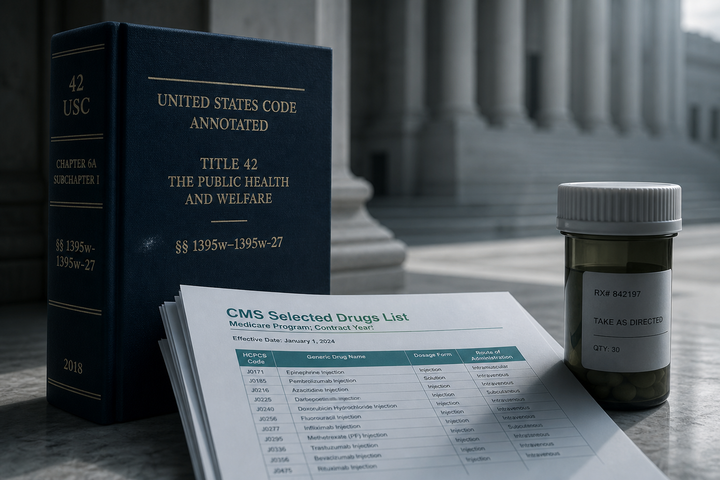
PhRMA sued CMS on October 7 over the GLOBE most-favored-nation rule for Medicare Part B. The final rule covers as few as four manufacturers and $440 million in projected savings. The suit's real target is the CMMI test authority beneath it.
FDA cleared Motivista as the first authorized treatment for negative symptoms of schizophrenia, but the pivotal trial showed a small-to-moderate effect against a control arm that also improved. The open question is whether payers will cover an app.
The FDA approved Atebrioz for FOP on a change in new bone volume, a measure the trial registry listed as secondary, after the lesion-count primary missed statistical significance at week 24.
Ultragenyx's AAV9 gene therapy is the first treatment for Sanfilippo syndrome Type A. Full approval on 17 treated children against a natural history control now collides with a diagnostic window most families still miss.
Curium’s Bexlutry is the first 505(b)(2) radioligand equivalent. The regulatory shortcut is done. Hospital clocks, isotope supply, and a pending $8 billion merger now decide whether Novartis’s NET franchise actually erodes.
Definium's Phase 3 Panorama study met its primary endpoint in generalized anxiety disorder with a 5.1-point HAM-A gap, testing whether an active 50 µg control and zero psychotherapy can clear the FDA hurdle that broke Lykos.
The FDA granted accelerated approval to AstraZeneca’s camizestrant based on ctDNA resistance signals before radiographic progression, overruling a 6-3 advisory committee vote and betting on a new oncology paradigm.
uniQure asked FDA for accelerated approval of AMT-130 on a 12-patient, 36-month high-dose dataset, after the agency twice reversed itself on external-control evidence.
The EU's centralized health technology assessment harmonizes clinical efficacy reviews across 27 member states, forcing drug developers to confront disparate national standards in Phase 3 trial design.
On 18 August the D.C. Circuit let Teva’s challenge to CMS’s “bona fide marketing” generic test go forward, while upholding CMS’s decision to treat Austedo and Austedo XR as one drug. That is not a repeal. It is a seam.
Multibillion-dollar factory expansions by Eli Lilly and Novo Nordisk are narrowing official FDA shortage lists, threatening telehealth compounding models built on unapproved peptide copies.
With over $200 billion in branded biologic revenues losing exclusivity by 2030, originator drugmakers are navigating secondary patent litigation under aggressive FTC antitrust scrutiny.