The Quiet Race to Shut Down Cancer’s Toughest Mutation
KRAS sat on the undruggable list for decades. Silexion's SIL204 is built to silence the mutation earlier in the cell, and the Phase 2/3 program is now moving into patients.

For most of the last three decades, KRAS was one of cancer drug development’s most frustrating dead ends.
Mutations in the gene help drive some of the world’s deadliest cancers, yet the protein they produce proved extraordinarily difficult to target. Unlike many proteins that offer obvious pockets where a drug can bind, KRAS has a relatively smooth surface that gave conventional medicines very little to grab onto. For years, researchers simply called it “undruggable.”
Silexion Therapeutics Corp. (NASDAQ: SLXN) is taking a different approach.
Rather than trying to block the mutated KRAS protein after a cancer cell has already produced it, the company’s lead drug candidate, SIL204, is designed to interfere earlier in the process, essentially telling the cell to stop making the harmful protein in the first place. It does that using small interfering RNA, or siRNA, a technology that can selectively silence genetic instructions inside a cell.
Silexion remains a tiny biotechnology company that most readers have probably never encountered. But it is now trying to apply that technology to one of the hardest problems in oncology.
Here’s why that effort is worth watching.
A Cancer That Has Resisted Decades of Progress
The immediate target is pancreatic cancer, one of the most difficult cancers to treat.
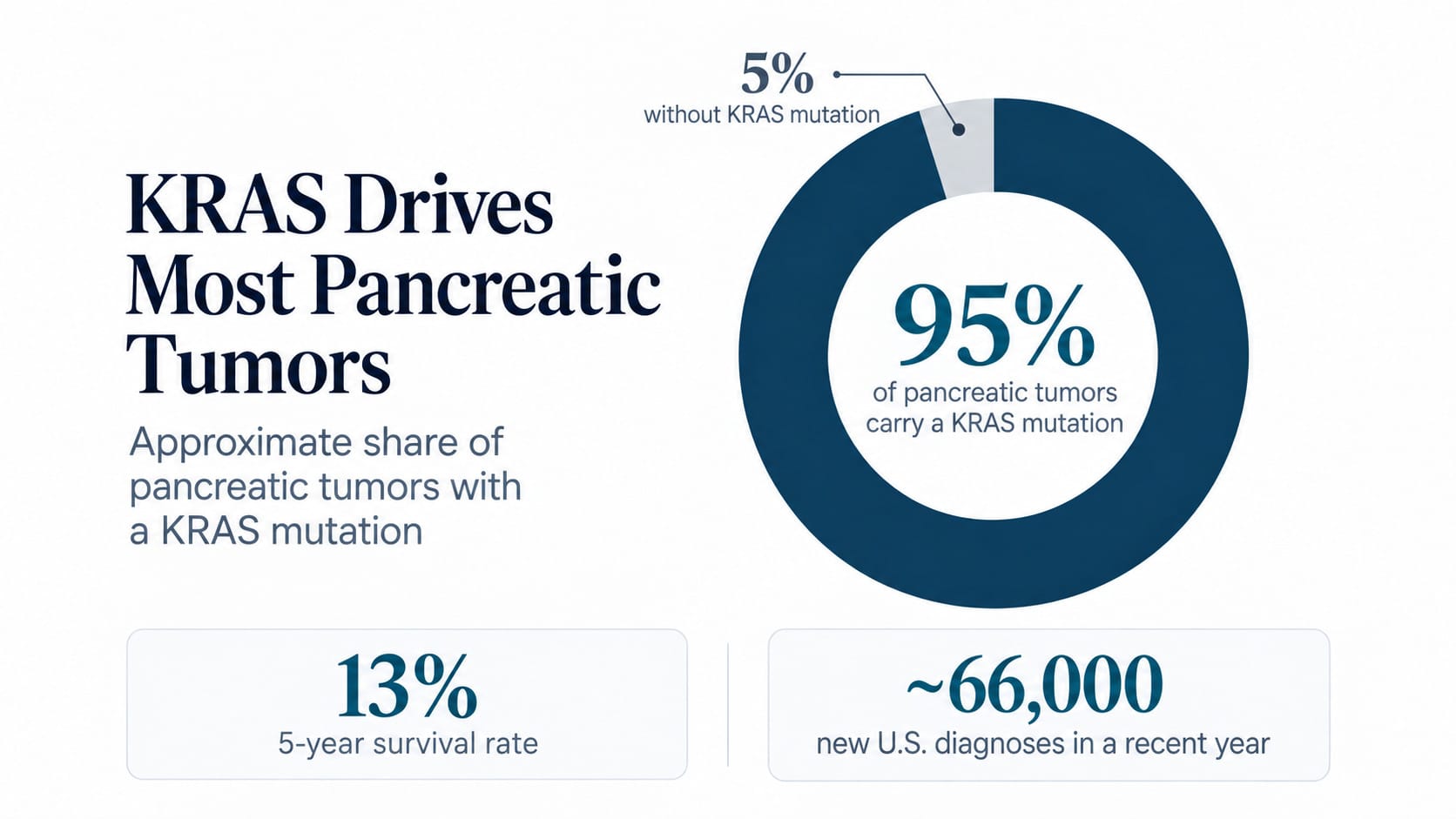
KRAS mutations are found in roughly 95% of pancreatic tumors. At the same time, the disease remains exceptionally lethal: the five-year survival rate is around 13%, while the American Cancer Society has estimated roughly 67,500 new U.S. diagnoses for 2026.
Treatment has improved over time, but progress has been stubbornly slow. Chemotherapy and newer targeted medicines have extended survival for some patients, yet pancreatic cancer continues to carry one of the poorest prognoses among major cancers.
That is the gap Silexion is trying to address.
SIL204 is a second-generation siRNA therapy that the company says has been engineered to improve stability and its ability to enter cells, two of the major challenges that have historically limited RNA-silencing approaches.
Instead of chasing the KRAS protein after it appears, the idea is to reduce production at the source.
From a Research Program to Actual Patients
For small biotechnology companies, there is an enormous difference between talking about a clinical trial and actually starting one.
Silexion has now crossed that threshold.
Israel’s Ministry of Health authorized the company’s Phase 2/3 trial in March 2026, followed by Germany’s BfArM in June. By late July, Tel Aviv Sourasky Medical Center, one of Israel’s largest academic hospitals, had been activated as the first clinical site and cleared to begin screening patients.
Additional sites in Israel and Germany are expected to join the study.
That transition matters. Early-stage biotechnology companies can spend years moving through manufacturing, regulatory and clinical preparations before a drug ever reaches patients. Silexion has moved beyond that stage and into the part of drug development where the central question can finally begin to be tested in people: does the therapy actually work?
A Second Possibility: Helping the Immune System See the Tumor
Silexion’s research may also have implications beyond directly suppressing KRAS.
During 2026, the company reported preclinical findings suggesting that SIL204 may change the way KRAS-mutant cancer cells interact with the immune system.
In laboratory studies involving pancreatic and lung cancer cells, treatment with SIL204 increased markers associated with helping the immune system recognize cancer cells while reducing a checkpoint-related protein that tumors can use to evade immune detection. The pattern appeared across four different KRAS mutation types.
That remains laboratory evidence, not proof of a benefit in patients.
But it raises an intriguing possibility: SIL204 could eventually be studied alongside immunotherapies such as Keytruda, which work by helping the immune system recognize and attack cancer.
If silencing KRAS can make tumor cells more visible to the immune system, the technology could potentially play two roles at once: weakening a fundamental cancer-driving pathway while making the tumor more vulnerable to immune attack.
Clinical studies would ultimately be needed to determine whether that effect translates into patients.
Small Enough to Be Almost Invisible
The other unusual part of the Silexion story is just how little attention the company currently receives.
With a market capitalization of roughly $2 million as of early September 2026 and relatively thin trading volume, Silexion sits at the extreme small end of the Nasdaq biotechnology universe. It is the kind of company that can easily escape institutional screens and mainstream investor coverage altogether.
That obscurity cuts both ways.
Like most clinical-stage biotechnology companies of its size, Silexion has relied on outside financing to fund development, and further clinical progress will require capital. Drug development is expensive, clinical trials can fail, and early-stage biotech investing carries substantial risk.
But the scientific and clinical progress is occurring regardless of how much attention the stock receives.
A company with a tiny public-market footprint has taken on one of cancer biology’s most notoriously difficult targets, secured authorization from regulators in two countries and moved its next-generation therapy into human clinical development.
Whether SIL204 ultimately succeeds is something only clinical data can answer.
For those who follow early-stage oncology, however, Silexion may present an unusual combination: an exceptionally difficult target, a differentiated scientific approach and a clinical program that has finally moved from the laboratory into patients.
For now, that makes it a small company tackling a very large problem, and one worth watching.
Recent News Highlights from Silexion Therapeutics Corp. (NASDAQ: SLXN)
Silexion Therapeutics to Participate in September 2026 Industry and Investor Conferences
Silexion Therapeutics Reports Second Quarter 2026 Financial Results and Provides Business Update
Silexion Therapeutics Announces Pricing of $2.5 Million Public Offering
Read this Next >>
Daraxonrasib Approval Shifts Pancreatic Oncology from Cytotoxic Care to RAS-Targeted Precision
Important Disclaimers and Disclosures: The author, Wall Street Wire, is a content and media technology platform that connects the market with under-the-radar companies. The platform operates a network of industry-focused media channels spanning finance, biopharma, cyber, AI, and additional sectors, delivering insights on both broader market developments and emerging or overlooked companies. Wall Street Wire is not a broker-dealer or investment adviser. References to market size estimates, valuations, price targets, or other third-party data are provided strictly for informational purposes. Wall Street Wire receives cash compensation from Silexion Therapeutics Corp. (the "Issuer") for coverage and awareness services, which are provided on an ongoing subscription basis. The content above is a form of paid advertising and promotion and is for informational purposes only and does not constitute financial or investment advice. This article may contain forward-looking statements about the Issuer's products, plans, or prospects that are subject to risks and uncertainties; actual results may differ materially, and readers should review the Issuer's public filings on SEC EDGAR (sec.gov/edgar) for full risk factors. Market size figures, research estimates, or other third-party data referenced in this article are quoted from publicly available sources believed to be reliable; however, we do not independently verify or endorse them, and additional figures or estimates may exist. Full compensation details, information about the operator of Wall Street Wire, and the complete set of disclaimers and disclosures applicable to this content are available at: wallstwire.ai/disclosures. This article has not been reviewed or approved by the Issuer prior to publication and should not be considered an official communication of the Issuer. Images may be computer generated and are for entertainment and visualization purposes only, and may not be an accurate or exact depiction of the technology.