
Repatha Is the First PCSK9 Drug Shown to Cut Death in Primary Prevention
A pre-specified VESALIUS-CV analysis found evolocumab cut all-cause death by 20% in high-risk primary prevention, with the benefit appearing only after 1.5 years and a 1.8-point absolute gap at five years.
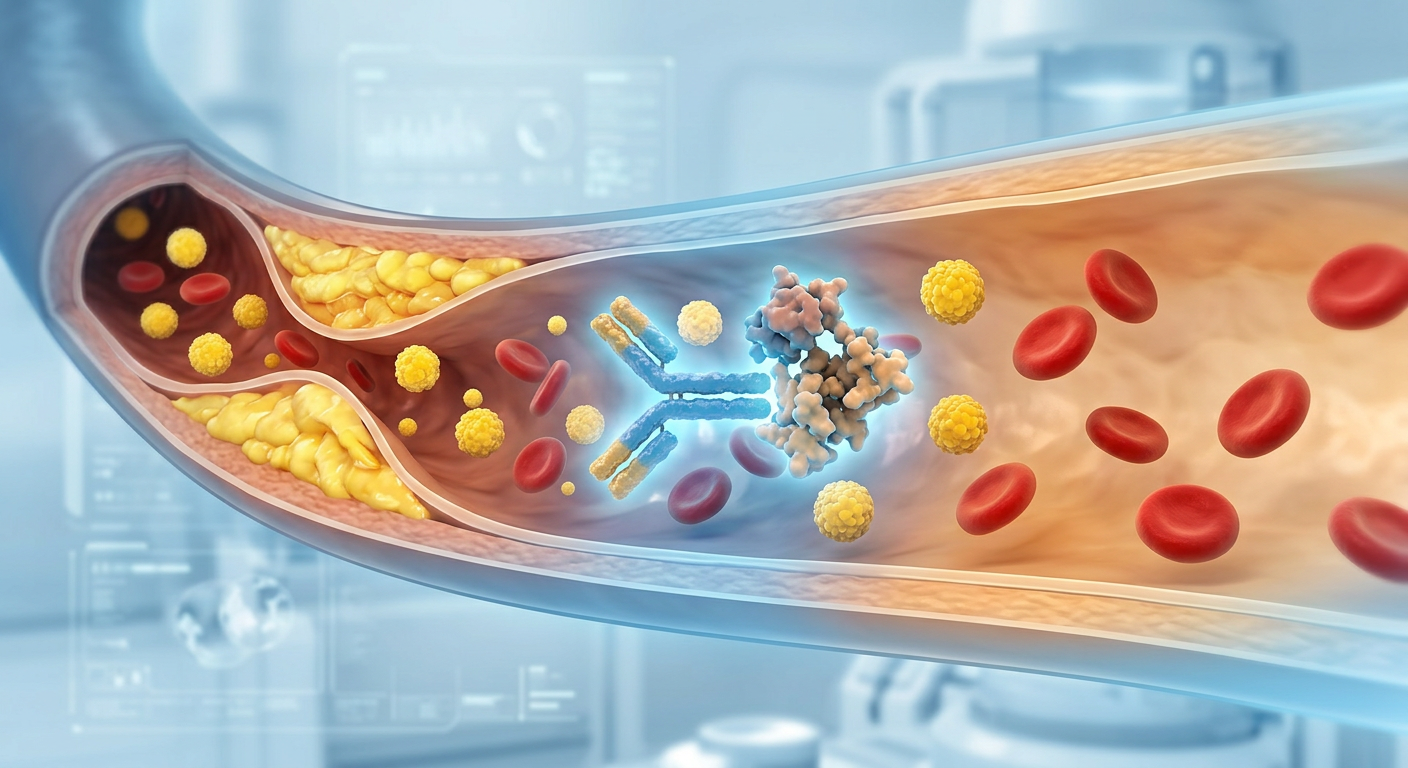
Amgen now has a Phase 3 mortality result no other PCSK9 inhibitor has shown in high-risk adults who have never had a heart attack or stroke. A pre-specified analysis of VESALIUS-CV, presented as a late-breaker at ESC Congress 2026 in Munich and published simultaneously in Circulation, found that evolocumab (Repatha) reduced the risk of death by 20% when added to statins or other LDL-C-lowering therapy. The reduction began after about 1.5 years of treatment. An earlier numerical mortality trend in the same program had not been statistically significant under hierarchical testing.
A 20 percent relative cut on a 1.8-point absolute gap
The Phase 3 trial randomized 12,257 patients (median age 66; 43% women) with qualifying atherosclerosis or high-risk diabetes, no prior myocardial infarction or stroke, and LDL-C of at least 90 mg/dL, or comparable non-HDL-C or apolipoprotein B thresholds, on optimized background lipid-lowering therapy. Patients received evolocumab 140 mg subcutaneously every two weeks or placebo. Median follow-up was 4.6 years.
973 patients, or 7.9%, died. Of those deaths, 36% were cardiovascular, 51% were noncardiovascular, and 13% were of undetermined cause. All-cause deaths numbered 434 in the evolocumab group versus 539 on placebo. Five-year Kaplan-Meier rates were 7.9% versus 9.7%, for a hazard ratio of 0.80 (95% CI 0.70-0.91; P = .0005), according to a detailed report of the Circulation paper.
That 1.8 percentage-point absolute difference over five years sits under Amgen's 20% relative-risk headline. Cardiovascular mortality moved in the same direction, with a hazard ratio of 0.79 (95% CI 0.64-0.98). Noncardiovascular mortality did not clear conventional significance, at 0.85 (95% CI 0.71-1.01). Deaths of undetermined cause did, at 0.64 (95% CI 0.45-0.92).
Delayed separation, and a testing hierarchy that once blocked the claim
A landmark analysis found no mortality difference during the first 1.5 years (HR 0.99), then a 27% relative reduction after 1.5 years (HR 0.73; P for interaction = .039). Amgen's release said the death reduction began to appear after approximately 1.5 years and continued through that 4.6-year median follow-up.
The lag fits a lipid-lowering mechanism that is supposed to work by preventing nonfatal events first. A multistate model estimated that approximately 78% of the treatment effect on noncardiovascular mortality could be statistically attributed to preventing antecedent nonfatal cardiovascular events. That estimate is model-based, not direct causal proof. More than half of the deaths in VESALIUS-CV were classified as noncardiovascular, which is why the model matters: the all-cause result is not simply a cleaner cardiovascular-death curve.
The primary VESALIUS-CV results, published in the New England Journal of Medicine in November 2025, had already shown a 25% relative reduction in a composite of coronary heart disease death, heart attack, or ischemic stroke (3-P MACE); a 19% reduction in a broader composite adding ischemia-driven arterial revascularization (4-P MACE); and a 36% reduction in the risk of heart attack. A NEJM editorial accompanying those results noted that PCSK9 inhibitors had previously shown benefit only among patients with a prior heart attack or stroke, and that earlier numerically fewer deaths "was not significant owing to the hierarchical testing approach" but was "likely to reflect a true signal."
LDL-C of 45 mg/dL, a 2015 approval, and a widening label
In a lipid sub-study, adding Repatha to maximally tolerated statin and/or ezetimibe yielded a median LDL-C of 45 mg/dL versus 109 mg/dL in the placebo group. The trial enrolled adults with known atherosclerotic cardiovascular disease or high-risk diabetes, no history of heart attack or stroke, on the highest tolerated statin and/or ezetimibe, with a median baseline LDL-C of 122 mg/dL.
Investigator Marc Sabatine described the first major cardiovascular event as "often a transition to a higher risk state," noted that evolocumab reduced subsequent events ("almost doubled the number of events prevented"), and endorsed intensive LDL-C lowering "down to ~40 mg/dL."
Repatha was first approved in 2015 and has been used by approximately 9 million patients globally. In August 2025 the FDA broadened Repatha's use to include adults at increased risk for major adverse cardiovascular events due to uncontrolled LDL-C. In August 2026 the European Commission approved an expanded indication for adults with established or high risk for atherosclerotic cardiovascular disease. Amgen's cardiometabolic pipeline also includes maridebart cafraglutide (MariTide) and olpasiran, an Lp(a) therapy.
For a drug that has been on the market for a decade, now used by millions and freshly expanded in both the United States and Europe, the new claim is specific. Repatha is the first and only PCSK9 inhibitor shown, in a Phase 3 trial, to lower the risk of dying from all causes in high-risk primary prevention patients. The absolute gap is 1.8 percentage points at five years. The Kaplan-Meier curves did not separate for a year and a half. Clinicians now have to decide whether that delayed, modest absolute mortality difference, stacked on MACE reductions already reported in 2025, is enough to change who gets intensive LDL-C lowering before a first heart attack or stroke.