
One Transfer RNA Molecule Controls Whether Prostate Cancer Stays Treatable
A Nature paper finds that one arginine transfer RNA, tRNA1 Arg(UCU), keeps prostate tumors on androgen receptor signaling. When it falls, cells slip into a lineage-plastic, AR-inhibitor-resistant state.
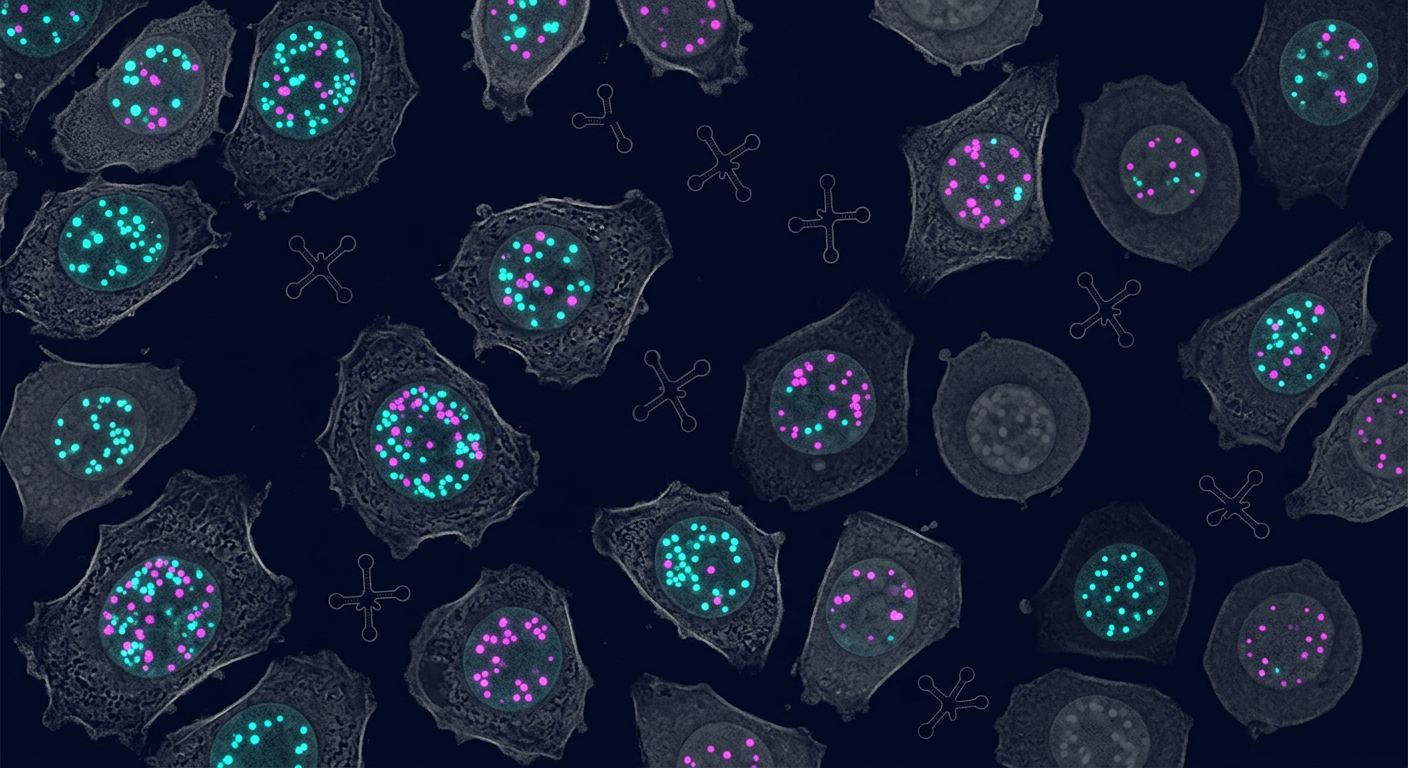
Prostate cancer is the archetype of a lineage-dependent cancer. It requires the androgen receptor for growth, which is why androgen deprivation therapy and second-generation AR pathway inhibitors (enzalutamide, apalutamide, darolutamide) anchor treatment of advanced disease. Genetic loss of TP53, PTEN or RB1, or treatment with AR pathway inhibitors themselves, can drive lineage independence through neuroendocrine differentiation or alternative cell states.
A Nature study led by Yeon Soo Kim and senior author Andrew C. Hsieh at Fred Hutchinson Cancer Center, with Tao Pan at the University of Chicago and Arvind R. Subramaniam among collaborators, now locates an unexpected switch. One transfer RNA, tRNA1 Arg(UCU), keeps tumors on the androgen receptor program. When its levels fall, cells escape into a lineage-plastic, drug-resistant identity.
One isoacceptor among 49
The team used multiplex small RNA sequencing on an engineered LNCaP model pushed into a lineage-plastic state by RB1 knockdown plus overexpression of mutant TP53 R175H, MYCN, ASCL1, SRRM4, NR0B2, BCL2 and mutant KRAS G12V. Among 49 tRNA isoacceptor families, only tRNA Arg(UCU) was significantly downregulated during the transition, with a log2 fold change of -0.338 and an FDR of 2.42 x 10^-25 by DESeq2, confirmed by edgeR. Within the five tRNA Arg(UCU) isodecoders, the specific species tRNA1 Arg(UCU) was the one that fell. Northern blots confirmed the drop in LNCaP and C4-2B cells.
That pattern held beyond the engineered line. Across nine prostate cancer cell lines, tRNA1 Arg(UCU) abundance correlated positively with androgen receptor activity (Pearson r = 0.85, P = 0.0034) and negatively with the neuroendocrine markers ENO2 and SCN3A (Pearson r = -0.72). In the LTL331 patient-derived xenograft, which transdifferentiates from adenocarcinoma to neuroendocrine prostate cancer after castration, tRNA1 Arg(UCU) levels fell stepwise from pre-castration through castration to neuroendocrine relapse.
The team built an in situ hybridization assay (BaseScope) to see the tRNA in patient tissue. Across 56 patients from the University of Washington rapid autopsy cohort, AR-positive tumors expressed higher tRNA1 Arg(UCU) levels than neuroendocrine-positive tumors (137 AR-positive versus 18 neuroendocrine-positive tumor regions on tissue microarrays). In the same cohort, tRNA abundance correlated positively with AR activity (Spearman r = 0.37, P = 0.018) and negatively with the neuroendocrine marker ELAVL4 (Spearman r = -0.36, P = 0.019).
Causal, not just correlative
The tRNA is causal, not just a marker. Inducible knockdown shifted LNCaP and C4-2B cells toward a neuroendocrine-like identity and made them resistant to enzalutamide, apalutamide and darolutamide, while making them more sensitive to alisertib, an Aurora kinase A inhibitor with activity in neuroendocrine prostate cancer. Re-expressing tRNA1 Arg(UCU) in lineage-plastic cells restored AR pathway gene expression, lowered neuroendocrine markers, and restored sensitivity to the AR inhibitors. Other arginine tRNA isodecoders and isoacceptors had no such effect. In androgen-insensitive LNCaP-abl cells, addback improved AR signaling.
Genetic proof came in mice carrying only one copy of n-Trtct2, the gene encoding tRNA1 Arg(UCU), crossed into the MYC-driven Hi-Myc prostate cancer model. Organoids from these haploinsufficient mice showed threefold increased resistance to AR pathway inhibitor treatment. After surgical castration at 9 months of age, castrated haploinsufficient mice had significantly enlarged prostate glands, and 25% showed large high-grade prostatic intraepithelial neoplasia glands versus 0% of castrated controls.
AGA codons, SWI/SNF, and unusual gene control
tRNA1 Arg(UCU) decodes the AGA arginine codon and controls a translational program centered on SWI/SNF chromatin remodeling components, with SMARCC2 as a key translational mediator maintaining lineage fidelity. TARDBP and ZSCAN29, two DNA-binding proteins, directly engage the genomic locus of tRNA1 Arg(UCU) to regulate its expression. The authors note this is non-canonical, tRNA-specific gene regulation.
Clinically, tRNA1 Arg(UCU) is downregulated in neuroendocrine prostate cancer, and its loss is associated with accelerated metastasis and poor survival.
A readout that still has to change a decision
No tRNA-directed cancer therapy exists today. Restoration of tRNA1 Arg(UCU) worked in cells and in mice. It has not been tested as a treatment in people. The near-term value is as a biomarker of lineage state and AR pathway inhibitor resistance: a molecular readout that tracks whether a tumor is still living on androgen receptor signaling. That signal is useful only if it changes a decision, such as when to stop leaning on AR-directed drugs or when to consider an agent with activity in neuroendocrine disease. The longer-term question is whether tRNA dosage can be therapeutically restored. Until that is shown in patients, the molecule maps the escape route. It is not yet a medicine.