
Novartis Invests $250 Million in Radioligand Manufacturing Infrastructure
A dedicated radiopharmaceutical production complex in Indianapolis aims to secure domestic actinium-225 and lutetium-177 supplies as oncology demand surges.
Radioligand therapies emerged as one of oncology's fastest-growing treatment modalities, delivering high-energy radioactive isotopes directly to surface receptors on malignant cells while sparing adjacent healthy tissue. However, commercial expansion has encountered severe logistical bottlenecks rooted in short isotope half-lives and highly specialized supply chains.
To overcome production constraints, Novartis invested $250 million to construct and validate a state-of-the-art radiopharmaceutical manufacturing site in Indianapolis. The automated facility is designed to manufacture commercial doses of lutetium-177 therapies, such as Pluvicto for prostate cancer and Lutathera for neuroendocrine tumors, while establishing dedicated cleanrooms for next-generation alpha-emitting actinium-225 candidates.
Corporate disclosures filed with financial regulators indicate the expansion will more than double Novartis's global radioligand production capacity, ensuring redundant regional supply nodes across North America, Europe, and Asia.
The Transition to Alpha-Emitting Isotopes
While beta-emitting lutetium-177 compounds proved commercial viability, alpha-particle emitters represent the next therapeutic frontier. Alpha particles deposit immense kinetic energy across extremely short distances, generating double-strand DNA breaks that malignant cells cannot repair while minimizing collateral radiation exposure to surrounding organs.
The primary barrier to broad clinical adoption remains the global shortage of medical-grade radioisotopes. Actinium-225 production requires high-energy cyclotrons and particle accelerators or nuclear reactor waste extraction. By securing multi-year isotope supply pacts and building in-house processing suites, commercial sponsors aim to insulate pivotal trials from raw material shortages.
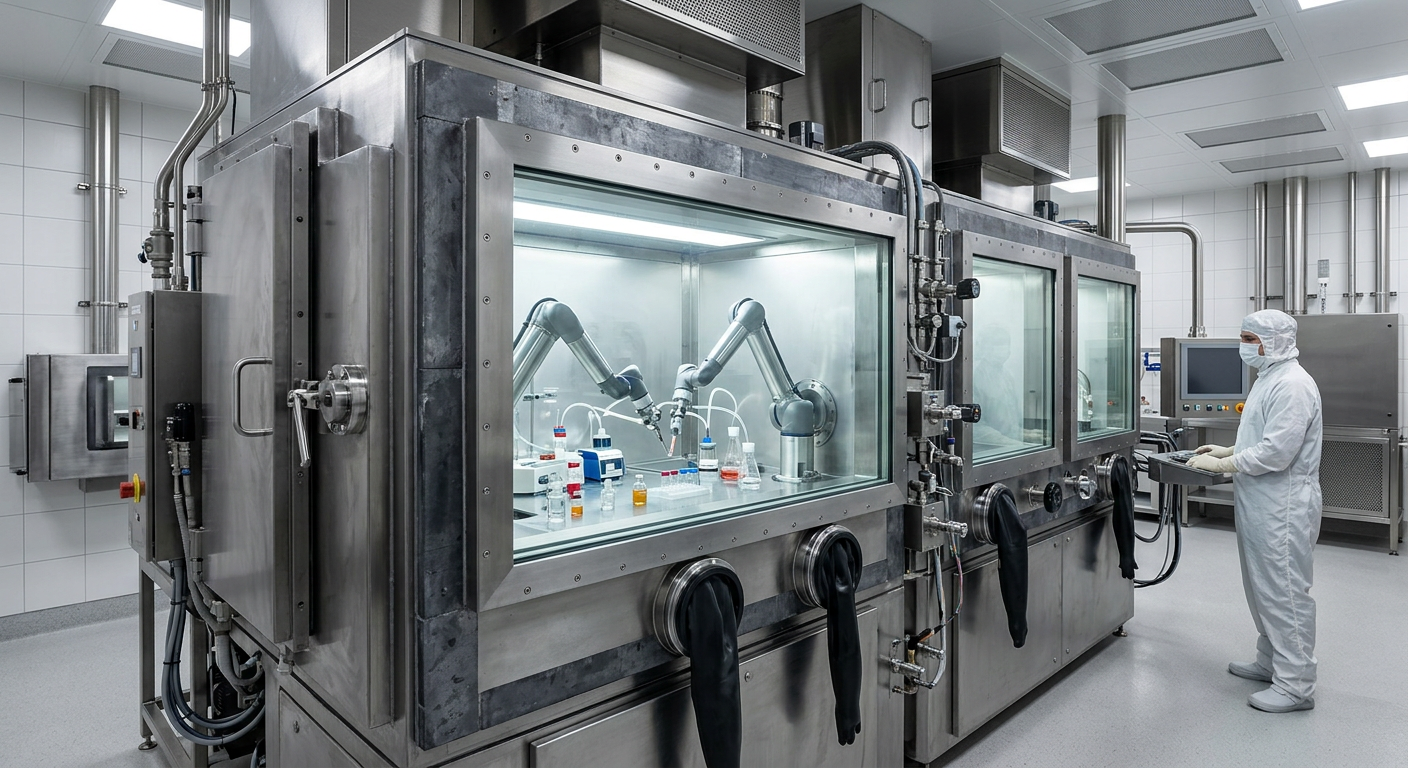
Furthermore, automated hot cell robotic systems minimize radiation exposure for manufacturing personnel while maintaining stringent sterile compounding standards.
Overcoming Just-In-Time Distribution Challenges
Unlike standard small molecules or monoclonal antibodies that remain stable on pharmacy shelves for months, radiopharmaceuticals possess decay half-lives measured in days or hours. Lutetium-177 exhibits a half-life of 6.6 days, requiring a synchronized logistical pipeline where individual patient doses are synthesized, tested for sterility and radiochemical purity, and flown to hospitals within 72 hours.
Establishing domestic manufacturing nodes adjacent to major air freight logistics hubs eliminates international transit delays, providing oncologists with dependable scheduling windows for late-stage cancer patients.