
What Jazz’s Ziihera approval means for trastuzumab - and for PD-1 - in first-line HER2+ gastroesophageal cancer
FDA cleared two zanidatamab regimens on 25 August, including a bispecific-plus-PD-1 combination for all HER2+ advanced GEA regardless of PD-L1 status, on Phase 3 data already in NEJM.
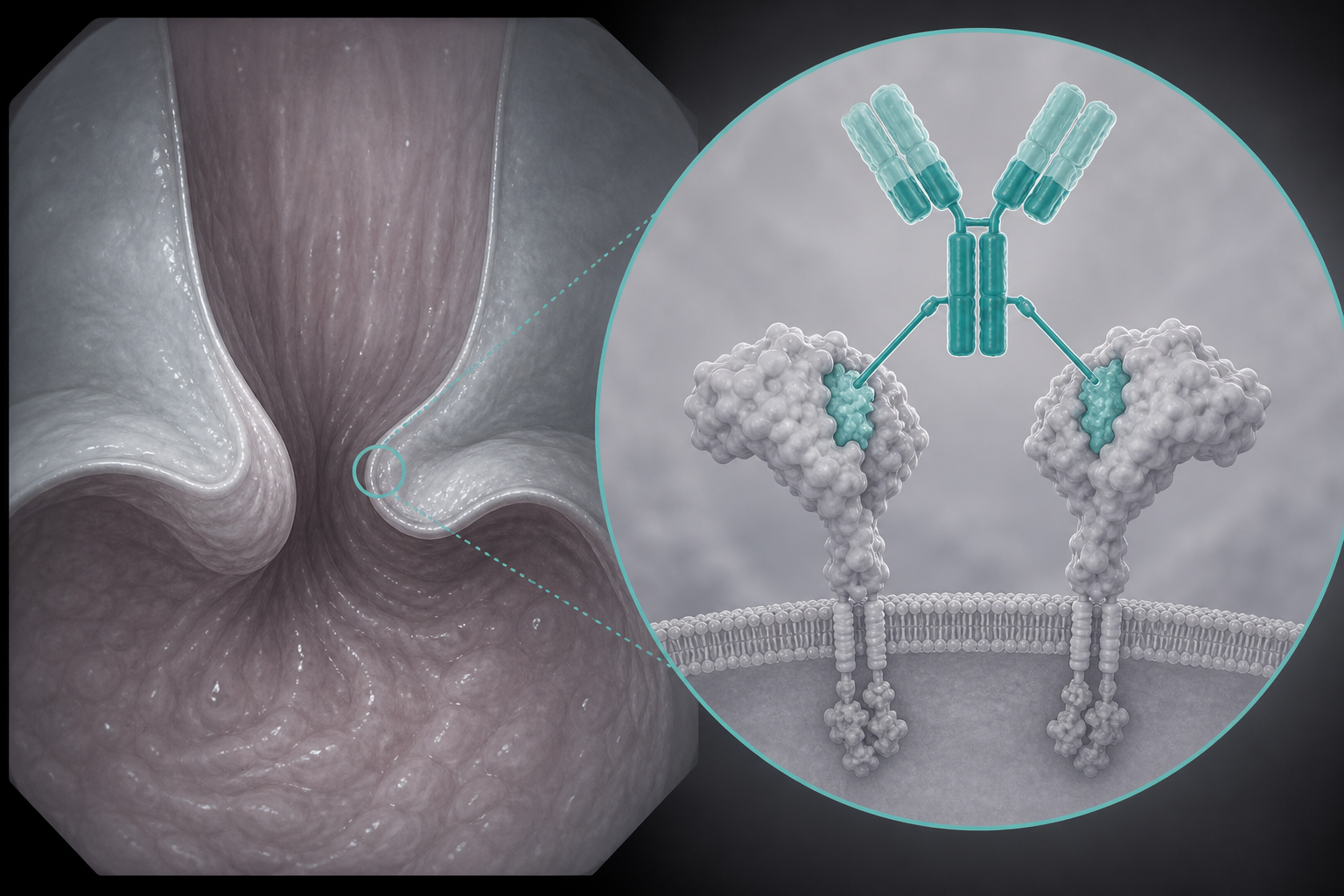
For fifteen years, first-line HER2-positive gastroesophageal adenocarcinoma has meant trastuzumab plus chemotherapy, with a PD-1 inhibitor layered on when PD-L1 testing said so. On 25 August the U.S. Food and Drug Administration wrote a different sentence. Jazz Pharmaceuticals announced two Ziihera (zanidatamab-hrii) regimens for unresectable locally advanced or metastatic HER2-positive GEA: the bispecific plus tislelizumab-jsgr (Tevimbra) plus fluoropyrimidine- and platinum-containing chemotherapy for IHC 3+ or IHC 2+/ISH+ disease, and the bispecific plus chemotherapy alone for IHC 3+ disease. The triplet’s label does not require PD-L1 positivity. That is the fight with Keytruda-era gastric practice, and it is a fight the trial was not designed to finish.
The molecule is not “another HER2 antibody.” Zanidatamab is a bispecific that binds two extracellular HER2 sites. Jazz and BeOne Medicines are developing it under license from Zymeworks; it was already approved in the United States for previously treated HER2-positive (IHC 3+) biliary tract cancer. What changed on 25 August is the ToGA-era first-line gastric standard.
What the label actually says
The ASCO Post’s FDA write-up is the cleanest map of the indication. The triplet is first-line for adults with HER2-positive (IHC 3+ or IHC 2+/ISH+) unresectable locally advanced or metastatic gastric, gastroesophageal-junction, or esophageal adenocarcinoma, as detected by an FDA-approved test. The chemotherapy-only doublet is first-line for IHC 3+ disease only. FDA also approved two companion diagnostics: PATHWAY anti-HER2/neu (4B5) and the VENTANA HER2 Dual ISH DNA Probe Cocktail.
That IHC split is not a footnote. ASCO Post, citing exploratory analyses, said the treatment effect in the chemotherapy-only arm was “primarily attributed to the subgroup of patients with HER2 IHC 3+ tumors.” In IHC 3+ tumors, zanidatamab plus chemotherapy produced a median progression-free survival of 14.2 months versus 7.6 months (hazard ratio 0.55). The agency wrote the narrower doublet indication because the IHC 2+/ISH+ benefit was not the driver. HER2 testing at diagnosis is now a dosing decision, not a yes/no flag.
The review used FDA’s Real-Time Oncology Review and Project Orbis, with Health Canada and the U.K. MHRA reviews ongoing. Priority review, Fast Track, Breakthrough Therapy, and Orphan Drug designations were already on the file. None of that is the clinical argument. The clinical argument is HERIZON-GEA-01.
The Kaplan-Meier, not the slogan
HERIZON-GEA-01 (NCT05152147) randomized 914 patients at about 225 sites in more than 30 countries, with dual primaries of progression-free survival by blinded independent central review and overall survival. Results were published in the New England Journal of Medicine and first presented at ASCO GI 2026; Jazz’s 27 May announcement of that publication is the company’s own contemporaneous record.
Both Ziihera combinations improved PFS versus trastuzumab plus chemotherapy. Median PFS was 12.4 months versus 8.1 months, a reduction of about 35% in the risk of progression or death in Jazz’s 25 August telling. The ASCO GI 2026 abstract splits the hazard ratios: 0.63 (95% CI 0.51-0.78) for the triplet and 0.65 (95% CI 0.52-0.81) for the doublet, both P < 0.0001 against trastuzumab plus chemotherapy.
Overall survival is where the two approved regimens part company. The triplet produced a median OS of 26.4 months versus 19.2 months, hazard ratio 0.72 (95% CI 0.57-0.90), P = 0.0043. ASCO Post reports the same numbers. Jazz called 26.4 months “the longest median overall survival reported in a Phase 3 trial in this setting.” That is a company comparison, not a network meta-analysis. What the table supports is a statistically significant OS benefit for zanidatamab plus tislelizumab plus chemotherapy versus trastuzumab plus chemotherapy.
The doublet does not have that OS claim. At the first interim analysis, zanidatamab plus chemotherapy showed median OS of 24.4 months versus 19.2 months, hazard ratio 0.80 (95% CI 0.64-1.01), P = 0.0564 , not statistically significant. ASCO Post says overall-survival interim results for the chemotherapy-only arm were not statistically significant at the time of the PFS analysis. Jazz said in May that a second OS interim was expected in mid-2026. The 25 August approval materials do not report that analysis. Until they do, the doublet’s approved claim is PFS in IHC 3+ disease, not a proven survival benefit.
PD-L1 is the other seam. Jazz said PFS and OS benefits were generally consistent across major prespecified subgroups, including PD-L1 status. The May release cited a PD-L1-negative (TAP <1%) subgroup OS of 29.7 months versus 15.8 months for the triplet against control. That is a subgroup, not a separately powered trial. It is why the triplet label does not require PD-L1 positivity. It is not proof that PD-1 adds equal benefit in PD-L1-negative disease for every patient. The control arm was trastuzumab plus chemotherapy. It was not a pembrolizumab-containing regimen. KEYNOTE-811-type practice is an open clinical question this label does not close.
Diarrhea is on the box
The U.S. prescribing information carries boxed warnings for diarrhea and embryo-fetal toxicity. In HERIZON-GEA-01, diarrhea was reported in 83% of patients on the triplet and 79% on the doublet , the most common adverse reaction in both arms. Loperamide prophylaxis was given in cycle 1. The pooled safety Jazz cites is harsher than the trial’s “most common” line: diarrhea in 85% of 330 patients treated with Ziihera plus chemotherapy plus tislelizumab, including fatal outcomes in 1.5%. Serious adverse reactions occurred in 59% of 294 triplet patients in HERIZON-GEA-01; diarrhea was the leading serious event (17%). Patients aged 65 years and older had more Grade 3 or 4 diarrhea (32% versus 20%) and more fatal adverse reactions (4.4% versus 0.6%).
Left-ventricular ejection-fraction decline was observed in 9% of the pooled triplet population, with one fatal left-ventricular-dysfunction outcome. Infusion-related reactions are in the warnings. This is a HER2 antibody. Cardiotoxicity is not optional reading next to a 26.4-month median.
What this does not settle
NCCN listing and payer placement were not done deals in the 25 August materials. Jazz said in May that it had submitted HERIZON-GEA-01 to NCCN. What the label did settle is narrower. A bispecific HER2 antibody plus chemotherapy beats trastuzumab plus chemotherapy on PFS. Adding tislelizumab adds a statistically significant OS benefit versus that same control, without a PD-L1 gate. The chemotherapy-only doublet is an IHC 3+ option whose survival analysis has not yet crossed the line. Diarrhea can be fatal. Test HER2. Do not pretend the comparator was Keytruda. The rest is practice, and practice has not voted.