
What $820 million for a Phase 1b/2 KCNT1 inhibitor says about rare-epilepsy assets - and about Jazz
Jazz agreed on 10 August to buy Actio Biosciences for $820 million cash plus $500 million in milestones, spinning out everything that is not ABS-1230, to bolt a precision ion-channel drug onto Epidiolex.
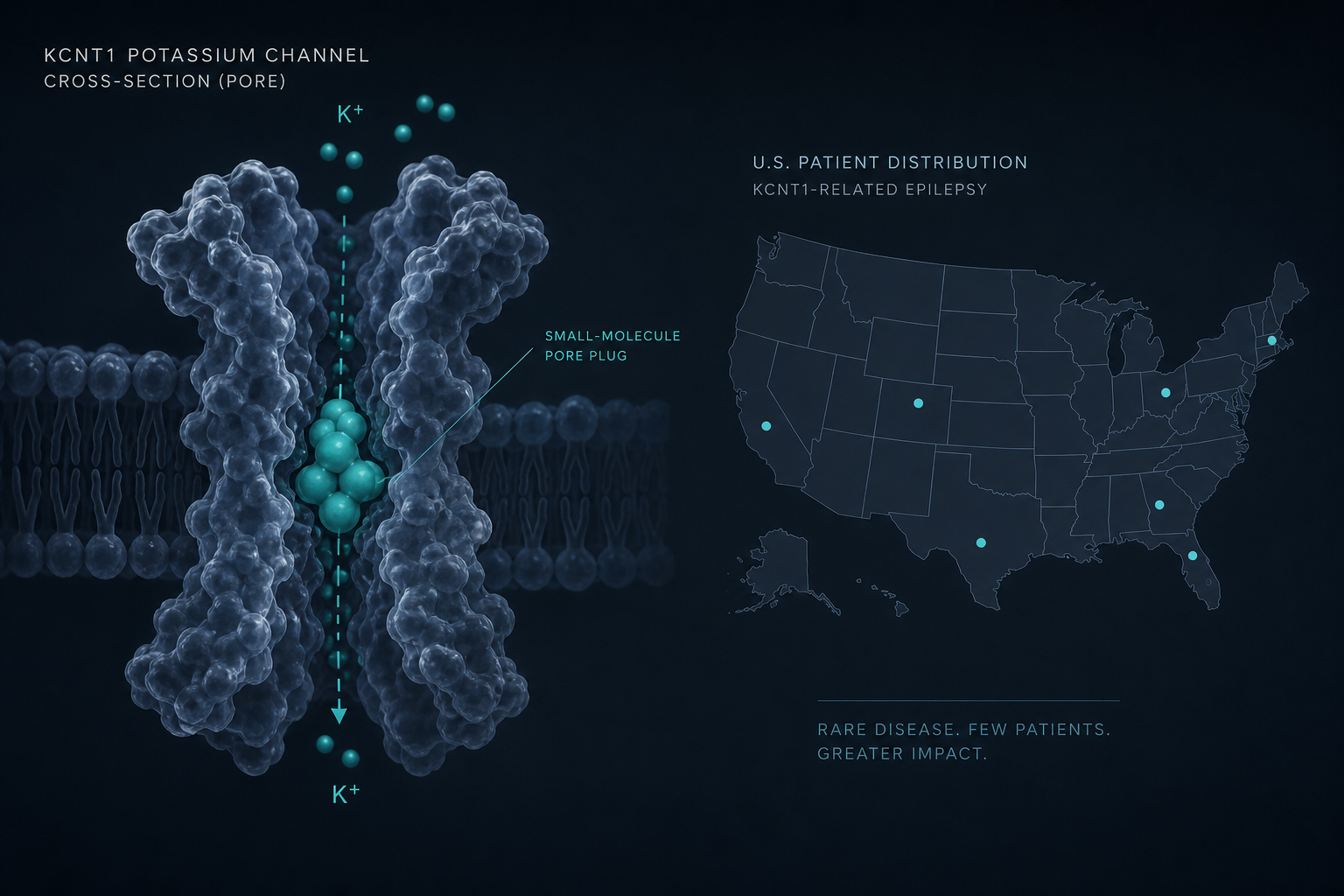
The price is the argument. On 10 August 2026, Jazz Pharmaceuticals agreed to acquire Actio Biosciences for $820 million upfront and up to $500 million in contingent consideration , and then, as a closing condition, to let Actio spin out everything that is not ABS-1230. Jazz is not buying a company. It is buying one oral KCNT1 inhibitor, a claimed registrational Phase 1b/2, and a stack of FDA rare-disease designations, in an indication the buyer says has no approved therapy and about 2,500 U.S. patients. That is 2026 rare-disease business development compressed into a single term sheet: genetically defined, ultra-rare, evidence-principle eligible, and structurally ring-fenced so the acquirer does not inherit the rest of the pipeline.
KCNT1-related epilepsy is a developmental and epileptic encephalopathy. Jazz’s description is clinical, not metaphorical: most patients experience dozens to hundreds of seizures a day that remain highly resistant to antiseizure medicines; about 80 percent have infantile onset; many never walk or speak. Later-onset disease presents as disruptive nocturnal seizures with cognitive and psychiatric comorbidity. There are currently no FDA-approved therapies. ABS-1230 is an orally available small-molecule KCNT1 inhibitor. In preclinical work, Jazz says, it inhibited the channel across evaluable pathogenic mutations , one molecule, in principle, for the mutation spectrum.
What the $820 million is actually purchasing
It is not purchasing a completed pivotal with a known effect size. Jazz’s clinical language is qualitative. ABS-1230 “recently demonstrated meaningful seizure reductions in an early clinical proof-of-concept trial in children with KCNT1 epilepsy.” The ongoing KYRON study is “designed to serve as the registrational study to support a new drug application submission in the U.S.” That is a design intent, not a result. ClinicalTrials.gov lists KYRON (NCT07600736) as a Phase 1b/2 trial , Jazz’s release calls it Phase 1b/2a , that is recruiting, with a start date of 18 May 2026 and a primary completion of January 2027. Estimated enrollment is 55. Participants are aged 1 month to under 22 years, with clinician-confirmed KCNT1-related epilepsy and at least four countable motor seizures per week. Part 2 randomizes ABS-1230 against placebo for 12 weeks on a primary of percent change in countable motor seizures. That is a small, short, genetically enriched study being asked to carry an NDA.
What makes the bid intelligible is the regulatory wrapper around that study, not a Kaplan-Meier. ABS-1230 has Fast Track, Rare Pediatric Disease and Orphan Drug designations, and it has been accepted into FDA’s Rare Disease Evidence Principles (RDEP) program, which Jazz describes as aiming to facilitate rapid development of ultra-rare disease therapies. RDEP is a process, not an approval. It does not equal accelerated approval, and it does not convert an early proof-of-concept into a label. It does tell a buyer that the agency has already agreed, in principle, to consider a thinner evidence package than a common-epilepsy program would face. For an indication of 2,500 U.S. patients, that agreement is part of what $820 million buys.
The 8-K filed the same day splits the $500 million of contingent consideration with more precision than the press release. Holders are entitled to $250 million on regulatory approval of a product containing ABS-1230 for KCNT1-related epilepsy; $100 million on first achievement of $500 million in annual net sales of products containing ABS-1230; and $150 million on first achievement of $1 billion in annual net sales. Half the earnout is a binary regulatory event. The other half is two commercial rungs that would require the drug, if approved, to become a rare-epilepsy product of unusual scale. Those sales tests are contractual, not forecasts. They do, however, reveal what Jazz is willing to pay for if the asset works, and what it is not willing to put in the upfront.
The spinout is the other half of the price
Concurrently with closing, Actio will transfer its non-ABS-1230 programs into a new privately held company funded by existing investors. Jazz takes a minority stake and certain related rights. The spinout’s lead is ABS-0871, a clinical-stage TRPV4 inhibitor for Charcot-Marie-Tooth type 2C and other TRPV4-related neuromuscular disorders, plus earlier programs. Actio has said it would pursue more prevalent indications later , additional genetic epilepsies for ABS-1230, overactive bladder for ABS-0871. That expansion story is not what Jazz is underwriting in the near term. The merger agreement makes completion of the spin-out a closing condition. Jazz is paying to keep KCNT1 and to put the rest somewhere else.
The deal has not closed. Jazz expects closing in the fourth quarter of 2026, funded with cash on hand and existing facilities, subject to customary conditions. The 8-K lists those conditions in the register that actually matters: HSR waiting-period expiration, other required governmental consents, adoption of the merger agreement by holders of at least 85 percent of Actio’s outstanding capital stock, absence of a continuing material adverse effect, continued employment of a specified employee, and completion of the spin-out. The end date is five months after 10 August. There is no termination fee. Antitrust and the spin-out are live, not ceremonial.
What the bid says about Jazz , and the category
Read as a comparable, $820 million cash for a pre-pivotal, single-study-registrational ion-channel drug in an ultra-rare DEE is a statement about scarcity. Genetically defined epilepsies with a causal channel, a pediatric onset, no approved therapy, and an FDA process already willing to entertain a small trial do not come up often. Jazz already commercializes Epidiolex; the release frames ABS-1230 as a bolt-on to that rare-epilepsy book rather than a new therapeutic area. That is a portfolio logic, not a proof that ABS-1230 will resemble cannabidiol commercially. There is no disclosed effect size from the early proof-of-concept, no published Phase 3, and no basis for analogizing the earnout rungs to anyone else’s peak sales.
The more useful reading is structural. Buyers of 2026 rare-neurology assets are paying up for a clean single-asset perimeter, an oral small molecule, and a regulatory conversation that has already started. They are not paying, in the upfront, for indication expansion into common epilepsies, or for the rest of the private company’s biology. They are putting $250 million of contingent value on a single KCNT1 approval, which is the honest way to write a contract when the Phase 1b/2 is still recruiting. Until KYRON reads out , primary completion is still listed as January 2027 , the $820 million is a price on an option, a designation stack, and a channel, not on a known seizure-reduction percentage.