
Dual-Payload ADCs Tackle Heterogeneous Resistance in Solid Tumors
Coupling topoisomerase inhibitors and microtubule disruptors onto a single antibody scaffold exerts simultaneous multi-pathway cytotoxic pressure to block emergent drug resistance.
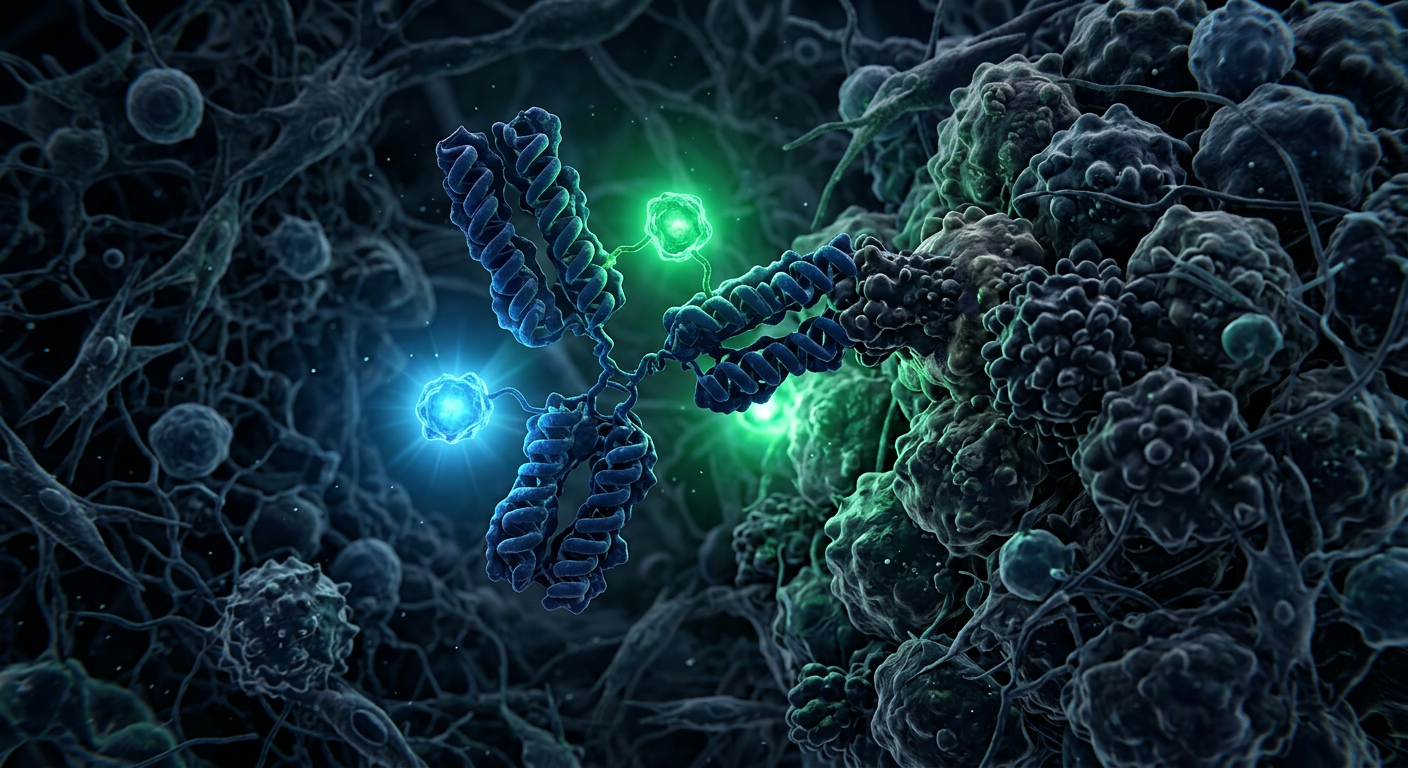
Antibody-drug conjugates (ADCs) established themselves as foundational pillars in precision oncology, demonstrating impressive progression-free survival extensions in breast, urothelial, and lung malignancies. Yet, despite dramatic initial objective response rates, the vast majority of patients with advanced solid tumors eventually relapse. Tumor progression is typically driven by emergent biological resistance: cancer cells downregulate target surface antigens, upregulate multidrug resistance efflux pumps, or acquire mutations in the intracellular target of the single cytotoxic payload.
To dismantle single-agent resistance pathways, protein engineers designed dual-payload ADCs: engineered monoclonal antibodies carrying two distinct, synergistic chemotherapeutic warheads on a single antibody scaffold. By delivering a topoisomerase I inhibitor alongside a microtubule disruptor (such as MMAE or an auristatin derivative), these therapeutics exert simultaneous, orthogonal lethal pressure across divergent cellular pathways.
Preclinical data presented in oncology proceedings demonstrated that dual-payload conjugates eradicated heterogeneous solid tumor xenografts that rapidly developed resistance to single-agent ADC equivalents, achieving durable complete remissions without requiring toxic systemic multi-drug infusions.
Overcoming Linker Stoichiometry and Hydrophobicity
The primary bioengineering obstacle in dual-payload synthesis is maintaining uniform drug-to-antibody ratios (DAR) without destabilizing the antibody. Attaching multiple hydrophobic cytotoxic payloads to an antibody scaffold often induces protein aggregation, triggering rapid hepatic clearance and systemic toxicity before the drug reaches tumor sites.
Next-generation platforms solve this through site-specific bioconjugation using engineered cysteines or non-natural amino acids, establishing a precise 4:4 payload stoichiometry. Furthermore, developers incorporate hydrophilic branched linkers with differential cleavage triggers: one payload is liberated by lysosomal cathepsin B cleavage, while the second requires intracellular glutathione reduction. This dual-release mechanism ensures coordinated intracellular payload delivery inside malignant cells.
Tolerability management remains the critical clinical hurdle. Delivering two distinct cytotoxins elevates risks of overlapping bone marrow suppression, neutropenia, and peripheral neuropathy. Phase 1 dose-escalation trials are establishing whether therapeutic synergy allows lower individual payload concentrations, expanding the therapeutic index.
Leveraging the Bystander Effect Against Antigen Loss
Solid tumors rarely exhibit uniform target antigen expression across all malignant clones. When therapies target a single surface protein, antigen-negative tumor cells readily escape and proliferate. Dual-payload ADCs maximize the 'bystander effect,' utilizing membrane-permeable payload designs that diffuse out of targeted cancer cells to destroy neighboring antigen-negative tumor cells and supporting vascular stroma.
With initial dual-payload oncology assets entering first-in-human clinical trials, this modular architecture represents a fundamental evolution in targeted drug delivery, packaging multi-agent combination chemotherapy into a single biotherapeutic molecule.