
Celldex Clears Chronic Hives in Half of Phase 3 Patients at an Anaphylaxis Cost
Barzolvolimab cleared hives in about half of Phase 3 CSU patients by week 24, including many Xolair failures, but two anaphylaxis cases sent Celldex shares down 13% ahead of a 2027 BLA.
Celldex Therapeutics posted a Phase 3 win in chronic spontaneous urticaria and still lost 13% of its market value before lunch. Barzolvolimab, the company's anti-KIT monoclonal antibody, drove complete hive and itch clearance in about half of patients by week 24 across two global studies that together randomized 1,939 people. The same release disclosed two cases of life-threatening anaphylaxis in a treatment group, with one anaphylaxis event also on placebo. Investors sold first and read the p-values later.
The commercial problem sits in that contradiction. A drug built to empty tissue of mast cells can erase hives that standard H1-antihistamines cannot touch, yet it can also rarely provoke the systemic allergic reaction those same mast cells drive.
Twin studies, one primary score
EMBARQ-CSU1 (N=963) and EMBARQ-CSU2 (N=976) evaluated patients whose urticaria stayed poorly controlled on antihistamines. Participants received barzolvolimab 150 mg every 4 weeks, 300 mg every 8 weeks, or placebo through a 24-week controlled period, with treatment continuing through 52 weeks. The registered trial continues to collect that longer follow-up.
The primary endpoint was least-squares mean reduction in weekly urticaria activity score (UAS7) at week 12. In EMBARQ-CSU1, placebo fell 10.7 points from a baseline of 30.9. The 150 mg arm fell 20.2 points from 30.6, and the 300 mg arm fell 20.5 points from 30.3 (both p < 0.00001). EMBARQ-CSU2 showed an identical spread: placebo dropped 11.4 from 29.3, 150 mg fell 20.2 from 29.7, and 300 mg dropped 19.7 from 29.6 (both p < 0.00001). Celldex's SEC filing details the findings across both cohorts.
The two doses were statistically equivalent on symptom reduction. That provides flexibility: an every-8-week 300 mg regimen offers a lighter clinic-visit schedule than monthly 150 mg, and the pivotal data do not force adoption of the more frequent arm.
Complete response, including Xolair failures
A UAS7 score of zero indicates complete absence of itch and hives. At week 12, EMBARQ-CSU1 posted complete response rates of 42.4% on 150 mg and 42.1% on 300 mg versus 9.3% on placebo (p < 0.00001). EMBARQ-CSU2 showed 45.7% and 44.0% versus 12.6% on placebo (p < 0.00001). Clearance rates climbed further by week 24: reaching 49.0% and 45.1% versus 15.4% placebo in CSU1, and 54.0% and 48.4% versus 17.6% in CSU2 (all p < 0.00001).
The omalizumab-refractory cohort represents the primary commercial opening. Among patients failing Xolair, week 12 complete response in EMBARQ-CSU1 reached 55.3% on 150 mg (p < 0.00001) and 44.3% on 300 mg (p = 0.00017) versus 9.3% placebo. EMBARQ-CSU2 reached 41.7% (p = 0.0089) and 46.4% (p = 0.0036) versus 15.1% placebo. Angioedema showed similar relief: complete resolution of swelling (AAS7=0) at week 12 reached 62.7% to 74.3% on 150 mg versus roughly 33.8% on placebo (p < 0.00001).
Cantor Fitzgerald analyst Kristen Kluska labeled the results the strongest Phase 3 dataset seen in pivotal urticaria trials, modeling $4.8 billion in peak sales. Yet the market reaction illustrates how safety concerns can clip market value even alongside category-leading efficacy.
KIT blockade empties the mast-cell compartment
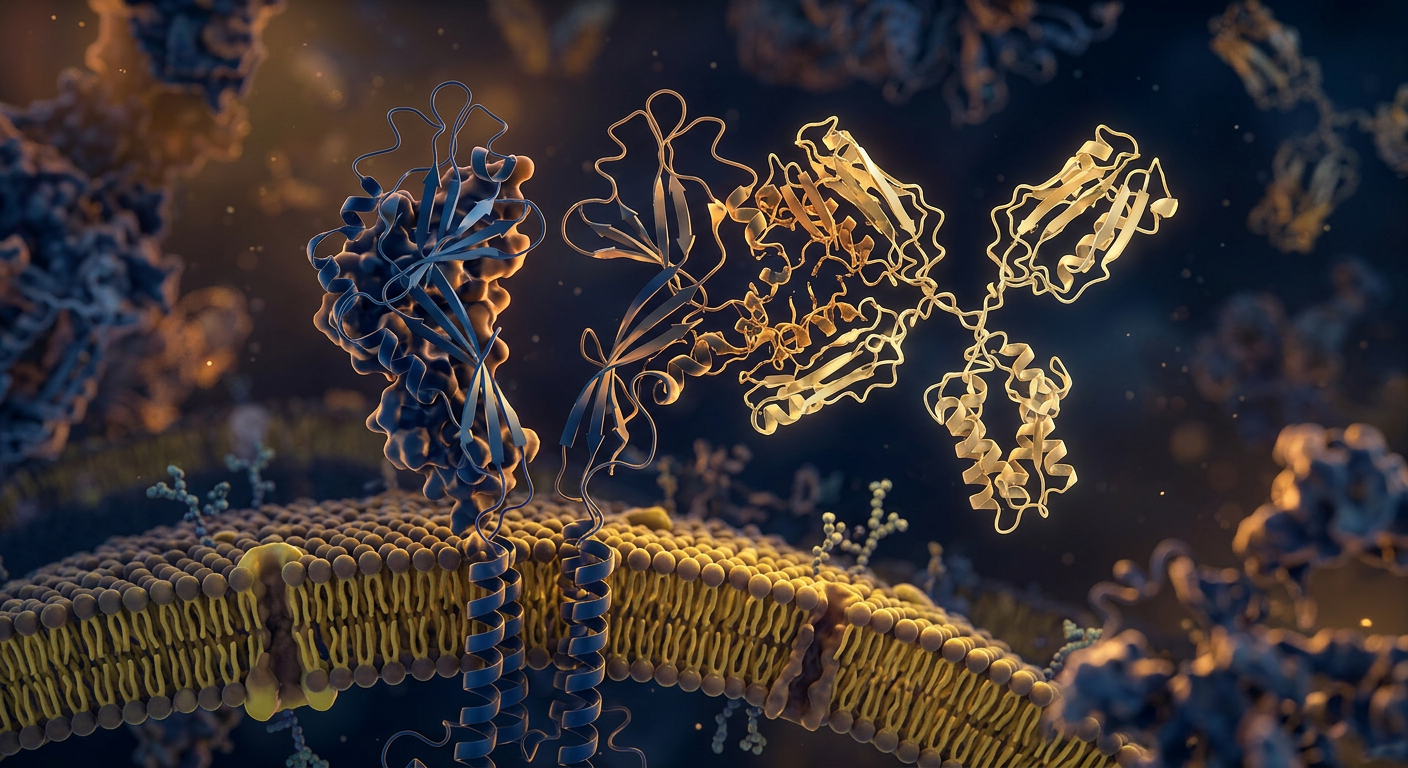
Barzolvolimab binds the extracellular domain of the KIT receptor (CD117), blocking stem cell factor signaling. Because mast cells rely on KIT for survival, receptor blockade depletes tissue mast cells at the root, shutting down histamine release more directly than IgE neutralization with omalizumab or IL-4/IL-13 inhibition with Dupixent.
That mechanism also drives expected class toxicities. Because KIT functions in melanocytes, hair depigmentation and skin hypopigmentation appeared as anticipated effects. Hematopoietic stem cells also express KIT, leading to observed neutropenia. Anaphylaxis, however, was unexpected during mast-cell depletion, creating the safety headline that triggered selling.
BioPharma Dive reported the 13% drop following the readout. CEO Anthony Marucci emphasized the overall incidence rate: two cases across approximately 2,400 treated clinical trial participants.
A 2027 BLA can absorb a warning
Stifel analyst Alex Thompson highlighted that existing biologics in the allergic space, including Xolair and Dupixent, carry boxed warnings or warnings for anaphylaxis. First-dose clinical monitoring represents an established management step rather than an insurmountable barrier for a biologic clearing hives in half of refractory patients.
Fifty-two-week treatment remains ongoing, with a Biologics License Application scheduled for 2027. Ahead of regulatory review, Celldex must establish that hypersensitivity remains rare as cumulative exposure grows, that neutropenia remains manageable, and that pigmentation changes do not hinder adherence. The Phase 3 efficacy threshold is met; regulatory positioning and labeling will dictate whether barzolvolimab competes as a preferred second-line biologic or sits reserved for omalizumab failures.
If 52-week data sustain the complete response curve without new safety clusters, Celldex holds a differentiated asset in biologic urticaria. The market moved quickly on the anaphylaxis signal, but the week 24 clearance rates remain the clinical foundation.