Bolt's Original Stockholders Own 6.9% After the Prana Reverse Merger
A sign-and-close reverse merger leaves Bolt's original stockholders with 6.9% of the company as Prana's IL-4Rα/TSLP bispecific inherits the Nasdaq listing, backed by a $120 million placement closing today.
Bolt Biotherapeutics' original stockholders own 6.9% of the company that still trades as BOLT. Holders of Prana Therapies own about 51.7%, and investors in a concurrent private placement own about 41.4%, measured fully diluted under the treasury stock method before beneficial-ownership caps. That split is the design of a sign-and-close reverse merger in which all of Prana's equity was exchanged for Bolt shares, together with $120 million of upfront gross proceeds from Series D non-voting convertible preferred stock and warrants that can add up to another $60 million. The private placement was expected to close today, October 26, 2026.
Neither the merger nor the financing required Bolt stockholder approval. Stockholders will be asked later only to convert the Series D preferred into common stock, according to an 8-K filing. Each Series D share converts into 1,000 common shares at $8,574.30 per preferred share, or $8.5743 as-converted. The syndicate includes Deep Track Capital, ADAR1 Capital, Andreessen Horowitz (a16z), LYFE Capital, Coastlands Capital, Eventide Asset Management, Casdin Capital, Curie.Bio, SilverArc Capital, Soleus Capital, Deviation Capital, and YK Bioventures. Proceeds are expected to fund operations into 2028 and through multiple clinical and preclinical milestones. Bolt scheduled a conference call for 8:30 a.m. ET today.
One molecule, two approved targets
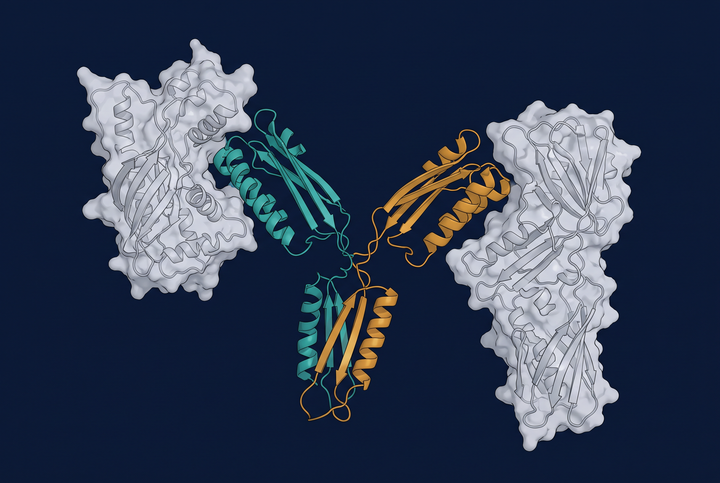
Prana is a clinical-stage company built around half-life-extended multispecific antibodies from its INSPIRE platform. The first clinical program, PRA-216, is a fully human, half-life-extended bispecific antibody targeting IL-4Rα and TSLP. It is in Phase 2 in asthma, COPD, and atopic dermatitis, with a Phase 2 study in eosinophilic esophagitis planned. Patient data from all four trials are expected beginning in the second quarter of 2027 and continuing through the fourth quarter of 2027.
The biology is a stack of two already commercial Type 2 pathways. Dupixent (dupilumab) is an approved antibody that targets the IL-4Rα subunit and thereby blocks IL-4 and IL-13 signaling. Tezspire (tezepelumab) is an approved antibody that targets TSLP. PRA-216 puts both into one molecule, pairing downstream IL-4 and IL-13 blockade through IL-4Rα with upstream TSLP inhibition, aimed at complementary drivers of inflammation.
Phase 1 healthy-volunteer data, presented as a late-breaking abstract at the 2026 European Respiratory Society meeting, showed PRA-216 was well tolerated and produced rapid, deep, durable pharmacodynamic activity across Type 2 biomarkers, including pSTAT6, serum TARC, blood eosinophils, and IgE. Bioavailability and extended exposure support potential at-home maintenance dosing every 8 to 12 weeks. A second program, an IL-31-containing bispecific for atopic dermatitis, is expected to enter first-in-human studies in the second half of 2027.
The immuno-oncology shell
That pipeline now sits on a Nasdaq issuer that, until this deal, was an immuno-oncology company. In first-quarter 2024 results, Bolt said it had refocused on its Phase 1 Dectin-2 agonist antibody BDC-3042. Its earlier identity was the Boltbody immune-stimulating antibody conjugate platform, including BDC-1001 in HER2-expressing tumors. The new capital and the new ownership are underwriting Prana's inflammation programs, not that prior focus.
Willie Quinn remains chief executive. Sheila Gujrathi, M.D., Prana's co-founder and former CEO, becomes Bolt's chief strategy officer and joins the board.
Cash into 2028, data in 2027
Type 2 inflammation is already occupied by large, validated antibodies. PRA-216's wager is that combining two of those targets in a half-life-extended format, with 8- to 12-week at-home dosing, can compete on convenience and breadth in a crowded field. The clinical test of that claim does not start to report until the second quarter of 2027, more than a year after today's close, and the remaining three indications stretch through year-end 2027. The Phase 1 signal was in healthy volunteers, not in patients with asthma, COPD, atopic dermatitis, or eosinophilic esophagitis.
Legacy Bolt holders, now a 6.9% stub, are along for that wait without having voted on the merger that produced it. Prana's holders and the new preferred investors control the combined company. The runway into 2028 is meant to cover the four Phase 2 data sets and the IL-31 program's first-in-human start. What it does not buy is any near-term proof that stacking two approved targets in one antibody is enough, in a market where each target already has a commercial drug of its own.