
What a GLP-1 antagonist means after a decade of turning the receptor on
Amylyx’s Phase 3 LUCIDITY hit on 18 August: avexitide cut Level 2/3 hypoglycemia 55% versus placebo in post-bariatric hypoglycemia , a first-in-class blocker of the same receptor the industry has spent years agonizing.
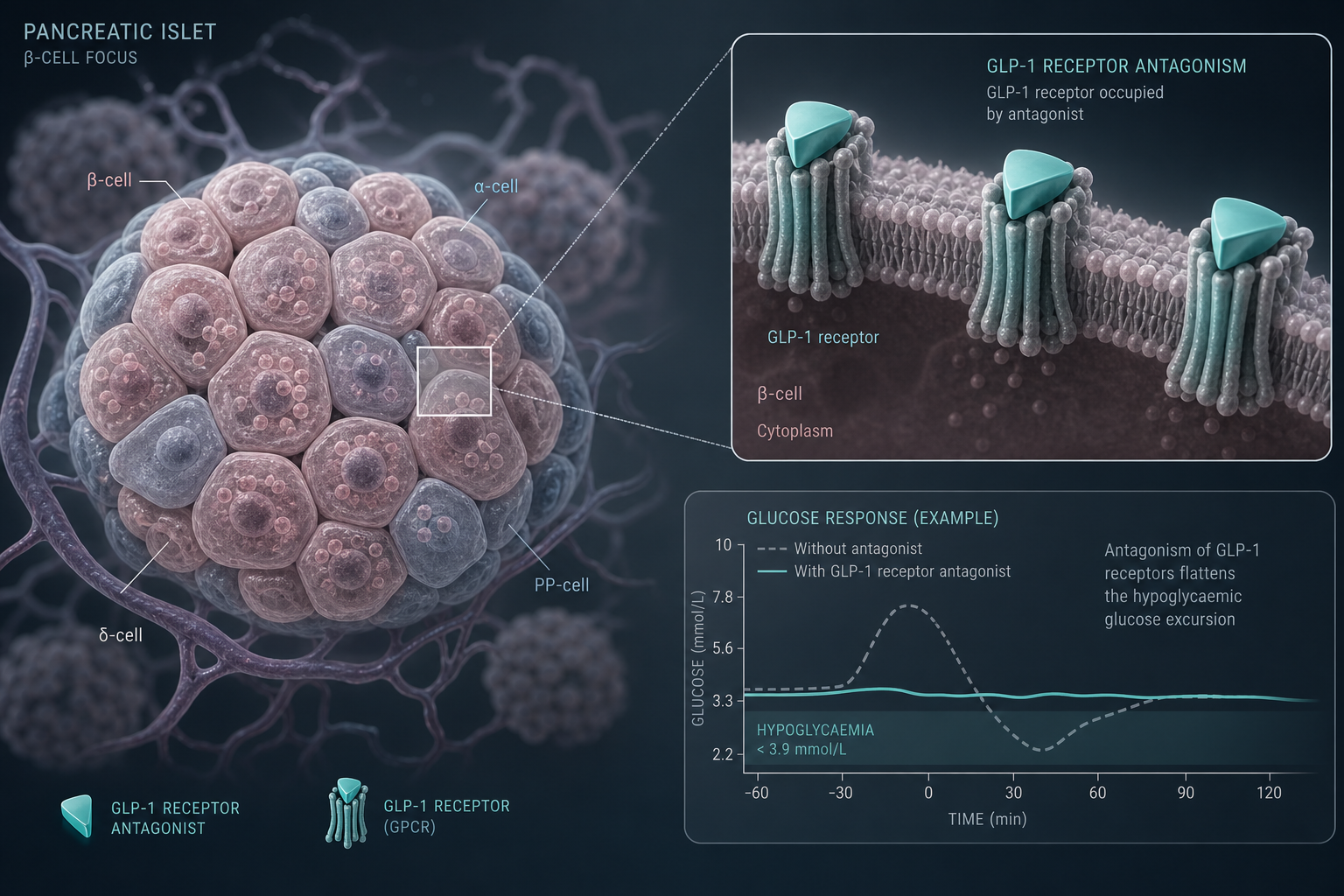
The last decade of metabolic medicine has been an argument about turning the GLP-1 receptor on. Agonists for diabetes, then obesity, then the oral follow-ons. On 18 August the same receptor showed up as the problem. Amylyx Pharmaceuticals announced that LUCIDITY, a Phase 3 trial of avexitide in post-bariatric hypoglycemia after Roux-en-Y gastric bypass, met its FDA-agreed primary endpoint: a 55% reduction in the composite rate of Level 2 and Level 3 hypoglycemic events versus placebo through week 16 (P = 0.000003). The same numbers are in the company’s 8-K of 18 August. This is topline, n = 78, sixteen weeks. It is also a first-in-class competitive antagonist pointed at a condition with no approved therapy.
Avexitide is not a weight-loss drug, an anti-obesity competitor, or a safety valve for agonist overuse. Weight did not change in either arm. The population is people whose post-bypass GLP-1 response is exaggerated, and whose insulin response then drives dangerous hypoglycemia. The industry spent a decade learning to push this receptor. LUCIDITY is what happens when the clinical job is to blunt it.
An FDA-agreed primary, n=78
LUCIDITY (NCT06747468) enrolled 78 adults with post-bariatric hypoglycemia following Roux-en-Y gastric bypass at 21 U.S. sites. Participants were randomized 3:2 to avexitide 90 mg subcutaneously once daily or placebo. Entry required Roux-en-Y at least twelve months before screening and at least three discrete hypoglycemic events during a three-week run-in despite dietary management. The protocol ran an up-to-six-week screening period with that run-in, a 16-week double-blind treatment period, and a 32-week open-label extension that is still ongoing.
The 18 August slide deck furnished with the 8-K is the only place the company put a confidence interval on the primary. In the intention-to-treat population of 78, avexitide produced a 55% reduction in the composite Level 2/3 event rate versus placebo, rate ratio 0.45 (95% CI 0.32-0.63), P = 0.000003. The same slides define the events: Level 2 is glucose below 54 mg/dL; Level 3 is altered mental and/or physical function requiring assistance. More than 90% of participants completed the 16-week double-blind period. The trial also met all secondary endpoints: Level 2 events by self-monitoring of blood glucose, Level 2 events by continuous glucose monitoring, and independently adjudicated Level 3 events. Amylyx did not publish the secondary point estimates. Those numbers are not in this piece.
Level 2 and Level 3 events are the reason a 55% rate cut is worth an NDA clock. These episodes can mean cognitive impairment, loss of consciousness, seizure, and the need for another person in the room. That is the clinical bar. It is not a surrogate. It is also not, at n = 78 and sixteen weeks, a practice-changing label. Full data have not been presented at a medical meeting. Amylyx said it plans to present them at one.
The receptor, inverted
The mechanistic claim is specific. In post-bariatric hypoglycemia, an exaggerated GLP-1 response , primarily to food , drives excessive insulin secretion and recurrent, often debilitating drops in blood glucose. Avexitide is a competitive GLP-1 receptor antagonist designed to bind GLP-1 receptors on pancreatic islet beta cells and inhibit that exaggerated insulin response. ClinicalTrials.gov identifies the molecule as exendin 9-39. Amylyx has now evaluated it in six clinical trials for PBH; LUCIDITY is the Phase 3. The same molecule has been studied in congenital hyperinsulinism. That is a separate program. LUCIDITY is not that trial, and a PBH NDA will not be an HI approval.
The epidemiology is the company’s. Amylyx estimates that PBH affects approximately 8% of people in the United States who have undergone the two most common bariatric operations, sleeve gastrectomy and Roux-en-Y gastric bypass , about 160,000 people. That is not a claims-database count. It is the sponsor’s prevalence estimate, and LUCIDITY itself enrolled only the Roux-en-Y population. There are currently no FDA-approved therapies for PBH. There were no changes in body weight in either the avexitide or the placebo group over the 16-week double-blind period. Blocking the receptor that agonists use to cut weight did not, in this trial, move the scale.
What the safety table allows
Avexitide was generally well tolerated through the double-blind period. The majority of adverse events were mild to moderate. There were no serious adverse events related to avexitide treatment. The most common adverse events were diarrhea, injection-site erythema, and injection-site bruising. Amylyx said the safety profile was consistent across all PBH trials completed to date. That is a company characterization of a still-unpublished integrated summary. What can be said from the 18 August disclosure is narrower: sixteen weeks, no treatment-related SAEs, gastrointestinal and local injection-site events in the lead.
FDA has granted avexitide Breakthrough Therapy designation for PBH and for congenital hyperinsulinism, Orphan Drug designation for hyperinsulinemic hypoglycemia, and Rare Pediatric Disease designation for congenital HI. Amylyx plans to submit a new drug application by the end of 2026 and is preparing for a potential 2027 U.S. launch if the application is approved. The 32-week open-label extension remains open. An expanded-access program launched in May remains open.
What this is not
It is not approved. It is not a substitute for the full dataset. It is not a weight-loss story, and it is not a referendum on the agonist class. Breakthrough Therapy status means FDA has already agreed the preliminary evidence justifies a faster file; it does not mean the file is in. The NDA clock Amylyx set , year-end 2026 , is the next fact that will matter. Amylyx is also the company that, on 4 April 2024, began voluntarily withdrawing Relyvrio (sodium phenylbutyrate and taurursodiol) after the Phase 3 PHOENIX trial in amyotrophic lateral sclerosis. Different molecule, different indication, different evidence bar. That history does not predict this NDA.
After a decade of turning GLP-1 on, the industry now has a Phase 3 hit for turning it down. Until the file is in, the result that can be defended from the 18 August paper is the one on the primary: a competitive GLP-1 receptor antagonist cut the composite rate of serious hypoglycemic events by 55% against placebo, with a P-value of 0.000003, in a condition the receptor’s other direction created as a surgical after-effect. It is also, for the moment, only topline. Treat it that way.